
Middle East Compostable Packaging Market UAE and Saudi Arabia Regulations Drive Shift Toward Sustainable Solutions

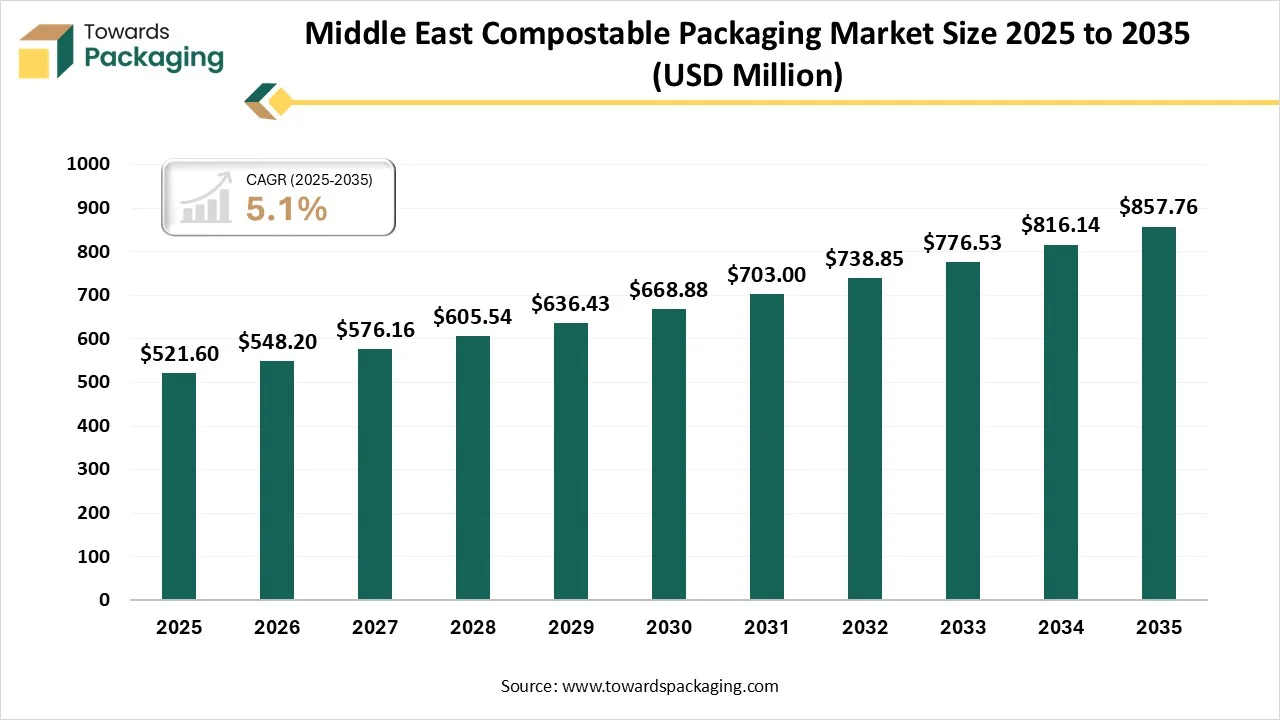
According to Towards Packaging consultants, the global Middle East compostable packaging market is projected to reach approximately USD 857.76 million by 2035, increasing from USD 521.6 million in 2025, at a CAGR of 5.1% during the forecast period 2026 to 2035.
Ottawa, March 03, 2026 (GLOBE NEWSWIRE) — The global Middle East compostable packaging market size stood at USD 521.6 million in 2025 and is projected to reach USD 857.76 million by 2035, according to a study published by Towards Packaging, a sister firm of Precedence Research.
Request Research Report Built Around Your Goals: [email protected]
What is Meant by the Compostable Packaging in the Middle East?
Middle East compostable packaging refers to eco-friendly, plant-based packaging materials (like PLA, starch blends, and cellulose) designed to break down into natural, non-toxic elements in industrial or home composting, aimed at reducing landfill waste in the region. Driven by strict regulations on single-use plastics and sustainability initiatives, this market serves the food & beverage, retail, and healthcare sectors.
Middle East Government Initiatives for the Compostable Packaging Industry:
- UAE National Single-Use Plastic Ban: This federal mandate prohibits the trade of single-use plastic bags and extends to plastic cups and cutlery by 2026, explicitly exempting certified compostable alternatives.
- Saudi Vision 2030 & Green Initiative: These frameworks involve massive investments in biodegradable material development and a goal to divert 94% of Riyadh’s waste from landfills through industrial composting.
- Qatar Regulation on Plastic Bags: A Ministry of Municipality law that requires all food establishments to replace traditional plastic bags with biodegradable, compostable, or reusable versions.
- Dubai Circular Economy Policy: This local initiative enforces waste segregation and provides incentives for businesses to adopt compostable packaging paired with local composting infrastructure.
- Oman Single-Use Plastic Bag Ban: A national policy that restricts the manufacture and import of non-biodegradable bags, forcing a shift toward compostable and eco-friendly alternatives.
What Are the Latest Key Trends in the Middle East Compostable Packaging Market?
- Material Innovation: There is a strong shift towards using advanced, locally suitable materials, including agricultural waste, seaweed, and mushroom-based (mycelium) packaging.
- Growing Consumer Awareness: Increased consumer demand for eco-friendly products has forced retailers to transition away from conventional plastics.
- Stringent Regulatory Frameworks: Governments in the GCC (specifically the UAE and Saudi Arabia) are pushing sustainability through bans on single-use plastics, driving a shift toward compostable alternatives.
What is the Potential Growth Rate of The Middle East Compostable Packaging Industry?
The Middle East compostable packaging industry is experiencing robust growth, driven by strict government bans on single-use plastics, rising consumer awareness of environmental sustainability, and the rapid growth of e-commerce. Governments in the UAE, Saudi Arabia, and Qatar are implementing bans, levies, and strict regulations on single-use plastic bags and items, forcing a shift towards compliant, certified compostable alternatives. The surge in online shopping and food delivery services across the region is increasing the demand for eco-friendly packaging that maintains quality and durability during shipping.
Get All the Details in Our Solutions – Access Report Sample: https://www.towardspackaging.com/download-sample/5976
Regional Analysis:
Saudi Arabia Compostable Packaging Market Growth Trends
The Saudi Arabia compostable packaging market, a major driver in the Middle East, is propelled by Vision 2030 sustainability initiatives, rising environmental awareness, and strict regulations on single-use plastics. increased e-commerce, strict government regulations on plastic waste, and the adoption of green technologies under economic diversification efforts are boosting demand. The market is characterized by a shift toward eco-friendly alternatives in the food service industry, where many establishments are transitioning to compostable, sustainable, and biodegradable materials.
The UAE Compostable Packaging Market Trends
The UAE compostable packaging market, driven by strict government bans on single-use plastics and rising eco-conscious consumer demand, is dominated by Polylactic acid (PLA) and paper-based solutions, particularly in food service and e-commerce, as the nation aims for a circular economy. The booming e-commerce sector is pushing for eco-friendly, durable, and lightweight packaging to meet the demand for sustainable shipping materials. Major players operating in this space include BASF SE, Mondi PLC, Tetra Pak, Amcor PLC, and Smurfit Kappa Group PLC.
More Insights of Towards Packaging:
- Recyclable Packaging Market Size, Trends, Key Segments, and Regional Dynamics with Manufacturers and Suppliers Data
- Reusable Packaging Market Size, Trends, Share, Segments, and Regional Insights (NA, EU, APAC, LA, MEA)
- U.S. Molded Pulp Packaging Market Size, Trends and Competitive Landscape (2026–2035)
- Vaccine Storage Packaging Market Size, Trends and Segments (2026–2035)
- Intelligent Packaging Market Size, Trends and Segments (2026–2035)
- Plastic Packaging Market Size and Segments Outlook (2026–2035)
- Lightweight Industrial Corrugated Packaging Market Size and Segments Outlook (2026–2035)
- Sustainable Aerosol Packaging Market Size, Trends and Segments (2026–2035)
- Poly-Woven Packaging Market Size, Trends and Segments (2026–2035)
- Mono-Material Cosmetic Tubes Market Growth, Trends & Forecast (2025-2035)
- U.S. Rigid Thermoform Plastic Packaging Market Size, Trends and Segments (2026–2035)
- Canada Plastic Packaging Market Size, Trends and Regional Analysis (2026–2035)
- Protective Packaging Market Size, Trends, Key Segments, and Regional Dynamics with Manufacturers and Suppliers Data
- Packaging in Supply Chain Management Market Size, Trends and Segments (2026–2035)
- North America Food Packaging Market Size, Trends and Segments (2026–2035)
- North America Blister Packaging Market Size, Trends and Regional Analysis (2026–2035)
- Pharmaceutical Temperature Controlled Packaging Solutions Market Size, Trends, Segments, Companies, Competitive Analysis, Value Chain & Trade Analysis 2025-2035
- E-Commerce Packaging Market Size, Share, Trends, Segments, Regional Outlook (NA, EU, APAC, LA, MEA), and Competitive Analysis 2025-2035
- North America Stick Packaging Market Size and Segments Outlook (2026–2035)
- Hot Drinks Packaging Market Size, Trends and Regional Analysis (2026–2035)
Segment Outlook
Material Type Insights
How Did PLA Segment Dominate the Middle East Compostable Packaging Market?
The PLA (polylactic acid) segment dominated the market in 2025, driven by high demand in food service, retail, and e-commerce for sustainable, rigid, and flexible, transparent, and flexible packaging. It is increasingly replacing conventional plastics like PET and PS in the region. Stricter regional regulations on plastic waste and growing consumer demand for eco-friendly products are pushing manufacturers to adopt PLA for cups, trays, and films.
The PHA (polyhydroxyalkanoates) segment is projected to grow at the fastest rate in the market for the forecast period, driven by sustainability trends and regulatory pressures on single-use plastics. This segment offers significant growth potential for eco-friendly, biodegradable solutions. The rapid expansion is supported by rising consumer demand for eco-friendly alternatives in e-commerce and food packaging. The shift is heavily driven by increasing investment in and adoption of sustainable materials in the region.
Application Insights
Which Application Segment Dominates the Middle East Compostable Packaging Market?
The food & beverage packaging segment dominated the market in 2025, driven by rising demand for sustainable, convenient, and ready-to-eat packaging solutions. This segment is experiencing rapid growth due to increasing consumer awareness of eco-friendly alternatives and government initiatives to reduce plastic waste. Key trends fueling growth include the adoption of trays, containers, bags, and pouches made from materials like sugarcane and paper, which offer sustainability and waste reduction.
The consumer goods & e-commerce segment is projected to grow at the fastest rate in the market for the forecast period, due to rapid e-commerce expansion, rising demand for sustainable mailers, pouches, and protective films. This growth aligns with regional sustainability initiatives and increasing consumer demand for eco-friendly alternatives. The rapid rise of online shopping in the region is accelerating the need for sustainable, compostable packaging solutions for shipping.
End-User Insights
How Did Quick Service Restaurants Segment Dominate the Middle East Compostable Packaging Market?
The quick service restaurants (QSRs) segment dominated the market in 2025 by leveraging high-volume demand for eco-friendly, single-use, takeout, and delivery packaging. This dominance is driven by strict government regulations against single-use plastics, rising consumer preference for sustainability, and the rapid expansion of food delivery services. Governments, particularly in the GCC, are actively banning single-use plastics and promoting sustainability initiatives, forcing QSRs to adopt compostable options.
The retail & supermarkets segment is projected to grow at the fastest rate in the market for the forecast period, driven by rising demand for sustainable, eco-friendly materials to reduce plastic waste. This shift is fueled by the rapid expansion of modern retail, including hypermarkets using compostable solutions, and a growing emphasis on environmental sustainability across the region. driven by rising demand for sustainable, eco-friendly materials to reduce plastic waste. This shift is fueled by the rapid expansion of modern retail, including hypermarkets using compostable solutions, and a growing emphasis on environmental sustainability across the region.
Recent Breakthroughs in the Middle East Compostable Packaging Industry
In November 2025, Emirates Biotech launched EMBIO, a new line of locally produced PLA biopolymers in the UAE, designed as a sustainable alternative to conventional plastics for packaging and food service sectors. The company is building a 160,000-tonne capacity production facility in KEZAD, expected to be operational by 2028.
Top Companies in the Middle East Compostable Packaging Market & Their Offerings
- Napco National: Offers the Gaia™ line of biodegradable paper bags and plant-based barrier coatings for the GCC food industry.
- Al Bayader International: Produces plant-based, industrially compostable tableware and containers made from sugarcane bagasse.
- Hotpack Global: Manufactures an extensive range of biodegradable paper lunch boxes, compostable cutlery, and Kraft food containers.
- BASF SE: Supplies ecovio® biopolymer resins used by local manufacturers to produce compostable waste bags and food films.
- Mondi Group: Provides certified compostable Kraft paper solutions for shopping bags and single-serve food packaging.
- Novamont S.p.A.: Supplies MATER-BI resins for the production of compostable carrier bags and agricultural mulch films.
- NatureWorks LLC: Produces Ingeo™ PLA biopolymers used as the raw material for compostable cold cups, cutlery, and coffee capsules.
- BioPak: Distributes a variety of plant-based foodservice products including FSC-certified paper bowls and BioCane containers.
- Vegware: Specializes in a complete range of plant-based catering disposables such as compostable hot cups and takeaway boxes.
- TIPA Corp Ltd: Develops fully compostable flexible packaging films and laminates designed to replace traditional plastic snack packaging.
- Avani Eco: Known for “bio-cassava” bags and plant-based takeaway containers that dissolve in water or compost.
- Ecoway Global L.L.C.: Supplies starch-based compostable resins and finished products like shopping bags and liners to the regional market.
- Plastopil Hazorea: Creates compostable flexible barrier films that provide food protection while meeting end-of-life sustainability standards.
- Falcon Pack: Provides a dedicated eco-line of biodegradable plates, trays, and boxes made from paper and bagasse.
- Huhtamaki Oyj: Manufactures compostable fiber-based products including coffee cups and molded trays for the hospitality sector.
Segment Covered in the Report
By Material Type
- PLA (Polylactic Acid)
- Starch Blends
- Bagasse & Molded Fiber
- PHA (Polyhydroxyalkanoates)
- Others (Cellulose/Seaweed)
By Application
- Food & Beverage Packaging
- Consumer Goods & E-commerce
- Personal Care & Cosmetics
- Industrial & Agriculture
- Others
By End-User
- Quick Service Restaurants (QSRs)
- Institutional & Catering
- Retail & Supermarkets
Invest in Our Premium Strategic Solution: https://www.towardspackaging.com/checkout/5976
Request Research Report Built Around Your Goals: [email protected]
About Us
Towards Packaging is a global consulting and market intelligence firm specializing in strategic research across key packaging segments including sustainable, flexible, smart, biodegradable, and recycled packaging. We empower businesses with actionable insights, trend analysis, and data-driven strategies. Our experienced consultants use advanced research methodologies to help companies of all sizes navigate market shifts, identify growth opportunities, and stay competitive in the global packaging industry.
Stay Connected with Towards Packaging:
- Find us on Social Platforms: LinkedIn | Twitter | Instagram | Threads
- Subscribe to Our Newsletter: Towards Sustainable Packaging
- Visit Towards Packaging for In-depth Market Insights: Towards Packaging
- Read Our Printed Chronicle: Packaging Web Wire
- Get ahead of the trends – follow us for exclusive insights and industry updates:
Pinterest | Medium | Tumblr | Hashnode | Bloglovin | LinkedIn – Packaging Web Wire | Globbook | Substack | Bluesky | Justdial | Crunchbase | TrustPilot | Bizcommunity - Contact: APAC: +91 9356 9282 04 | Europe: +44 778 256 0738 | North America: +1 8044 4193 44
Our Trusted Data Partners
Precedence Research | Towards Healthcare | Towards Food and Beverages | Towards Chemical and Materials | Healthcare Webwire | Packaging Webwire | Precedence Research Insights
Towards Packaging Releases Its Latest Insight – Check It Out:
Sustainable Wipe Packaging Market Size and Segments Outlook (2026–2035)
Seafood Packaging Market Size, Trends and Segments (2026–2035)
Tobacco Packaging Market Size and Segments Outlook (2026–2035)
Europe Pharmaceutical Packaging Materials Market Size, Trends and Competitive Landscape (2026–2035)
North America Tin Cannabis Packaging Market Size and Segments Outlook (2026–2035)
Semi-Automatic Stretch Wrappers Market Size, Trends and Competitive Landscape (2026–2035)
Cut Flower Packaging Market Size, Trends and Segments (2026–2035)
Clear Plastic Film Market Size, Trends and Competitive Landscape (2026–2035)
Edible Packaging Market Size, Trends and Regional Analysis (2026–2035)
Glass Packaging Market Size, Trends and Regional Analysis (2026–2035)
Pouch Materials for Pharmaceutical Market Size and Segments Outlook (2026–2035)
Polypropylene Containers Market Size, Trends and Segments (2026–2035)
Solid Board for Food Packaging Market Size, Trends and Competitive Landscape (2026–2035)
High Impact Polystyrene (HIPS) Film and Sheet Market Size and Share 2025-2035
Corrugated Packaging Market Size, Trends and Regional Analysis (2026–2035)
Pet Food Packaging Market Size, Trends and Segments (2026–2035)
Sugarcane-Based Packaging Market Size and Segments Outlook (2026–2035)
Composite Packaging Market Size, Trends and Segments (2026–2035)
Cohesive Packaging Market Size, Trends and Competitive Landscape (2026–2035)
Recyclable mono-material PE Market Size, Trends and Competitive Landscape (2026–2035)
 Disclaimer: The above press release comes to you under an arrangement with GlobeNewswire. DailyIndiaNews.com takes no editorial responsibility for the same.
