
Transforming cybersecurity with AI-driven Project Perception

In today’s digital world, the landscape of cybersecurity is evolving rapidly. With the advent of autonomous systems that can reason, adapt, and operate around the clock, the traditional methods of cybersecurity are becoming less effective. The reality is that as the cost of launching cyberattacks decreases, the scale and complexity of potential threats increase. Attackers are able to create exploits more swiftly, extend their reach, and operate with remarkable efficiency. The strategies developed for a world primarily involving human actors are inadequate for a reality dominated by artificial intelligence, automated agents, and fast-paced attacks.
Introducing a new Cyber Stack
The need for an innovative Cyber Stack has become clear. Such a system must have the capability to continuously assess risk across an entire digital environment, analyze vast amounts of data, and respond at machine speed. It is essential that this system evolves with changing environments to help organizations stay a step ahead of potential threats. Ultimately, because cybersecurity is a mission for humans, it should enhance the capabilities of defenders by providing them with deeper insights and more effective tools. The hallmark of the next generation of security systems will be their ability to continuously perceive, reason, and act, rather than simply generating more alerts.
Project Perception: A new age of security
This vision has led to the development of Project Perception, an advanced security system designed to meet the challenges posed by AI. The project utilizes AI to transform signals into real-time protections, effectively defending against AI-driven threats. By integrating signals, context, models, and specialized agents, Project Perception creates a defense system that continuously learns and adapts. It can analyze, prioritize, and take action at machine speed, all while keeping human operators in control and equipping them with powerful new tools.
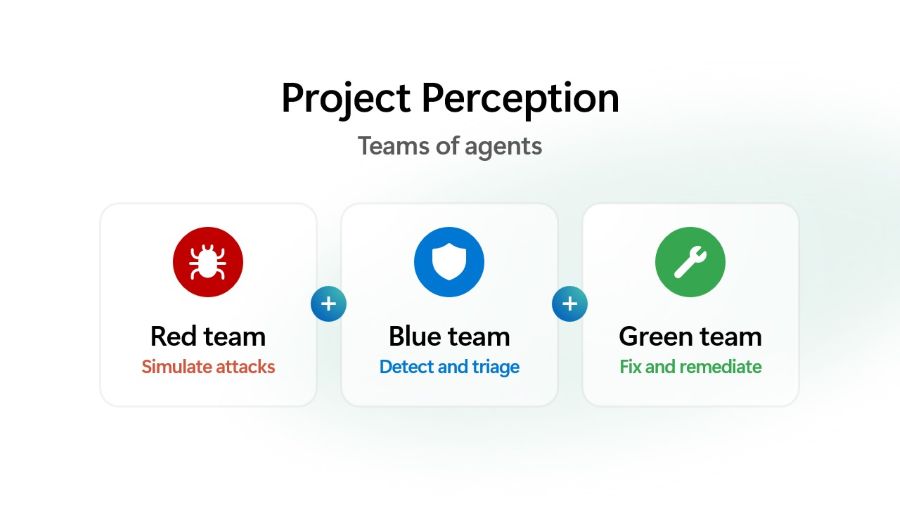
Project Perception operates on a straightforward principle: effective defense requires a continuous understanding of an attacker’s perspective, a defender’s risk assessment, and how protections can improve over time. To achieve this, it coordinates three types of specialized agents. Red team agents identify potential vulnerabilities before they can be exploited. Blue team agents investigate, consider context, and discern significant risks. Green team agents implement corrective measures and strengthen defenses. Together, these agents form a closed-loop system that continuously evaluates and enhances an organization’s security posture.
Leveraging Microsoft’s capabilities
The effectiveness of a system like Project Perception depends on its visibility, the actions it can undertake, the expertise of the teams behind it, and the models in use. Microsoft combines these elements by providing broad visibility across identities, endpoints, applications, data, clouds, and AI systems. This comprehensive view allows for decisive actions across these environments. Supported by decades of security research, threat intelligence, and practical experience, these capabilities shape how Project Perception responds to threats.
Security demands a continual, around-the-clock commitment. Organizations require protection that is not only effective and constantly available but also affordable at scale. This involves more than just using the most advanced models; it requires the application of the right model to the right task. Project Perception adopts a multi-model architecture, combining both advanced and specialized cyber models to optimize quality and cost.
As part of this strategy, the project aims to offer the best models for each security task, including innovations with specialized models. The initial focus is on software vulnerability management, incorporating MAI-Cyber-1-Flash within MDASH, our multi-model team dedicated to software vulnerabilities. This configuration achieves a 96% score on the industry-leading CyberGym benchmark, outperforming Mythos by 12 points, while also delivering nearly 50% in cost savings compared to the current MDASH configuration. This demonstrates the power of a well-optimized, multi-model system with access to extensive historical training data. Project Perception plans to extend the use of MAI-Cyber-1-Flash to a broader range of security workflows beyond software vulnerabilities.
On August 3, Project Perception will be available for public preview, bringing this advanced vision of cybersecurity to customers worldwide.


